Cold weather fuel leak
We were out running errands the other night when the smell of fuel started filling the cabin of my 2002 Subaru Impreza. At first I thought it might be another car in traffic, but quickly realized that the obnoxious odor was coming from my engine bay. One of the Service Managers at a Subaru dealer had warned me about this a few months prior, but I didn't realize that it was related to the cold weather. Apparently when it's cold enough outside (which it has been here) one of the fuel hoses contracts and fuel leaks out onto the passenger side of the engine (near the turbo.) Subaru of America has acknowledged this design flaw with a service bulletin, but it's not considered a recall or warranty work (which I guess means it's little more than a warning that it happens, and that some re-designed parts are available to solve the problem at the owner's expense.)
Before doing anything with the car I searched through NASIOC (North American Subaru Impreza Owner's Club) to learn more about the problem. Interestingly enough, there have been over 10 other local owners in the past couple days that have posted about the exact same problem. (It's unusually cold right now.)
The next day I stopped by a local Subaru dealer only to be sadly disappointed with their interpretation of "customer service". Since I recently moved, I don't know where the best places in town are for this kind of thing, but I can tell you that this particular dealer won't be getting any of my business. They were terrible, which was particularly bad since the local dealer in my old town was amazing. So instead of giving my business to these guys, I've ordered the parts from an out-of-state dealer who's always been pleasant. I also made a point to post to some of the boards about the poor service at this dealer.
I bring all this up for a couple reasons: (1) If you have a 2002 WRX getting up near 50k miles, there's a known issue with the fuel line on the passenger's side of the engine (under the intake manifold.) If you're still under warranty, I'd go in and complain about a fuel smell just to get the work done. (2) Subaru is aware that this first batch of WRX's leak fuel when cold, but haven't recalled it. And finally, (3) I love my car, and everyone I know who owns one loves it too -- but all it takes is one jackass (actually two) at a dealer to make potential customers post bad things to their blogs and discussion boards ;-)
[Update: 2009-01-18]
There's a post in the comments suggesting that you can simply tighten the fuel hose clamps to stop the leak. It will take a little effort to get to the right one, but if it works, this will save you from a considerable repair bill.
[Update: 2007-03-20]
I've noticed that this post (and my Texas heat and a coolant leak post) still get quite a few hits, so I thought I'd add some extra info (and turn comments on, which they should be now.) First, the fuel leak is caused by a short section of rubber fuel line that connects two sections of hard line under the intake manifold. When cold, everything contracts, and there's a possibility for fuel to spray out from the connection.
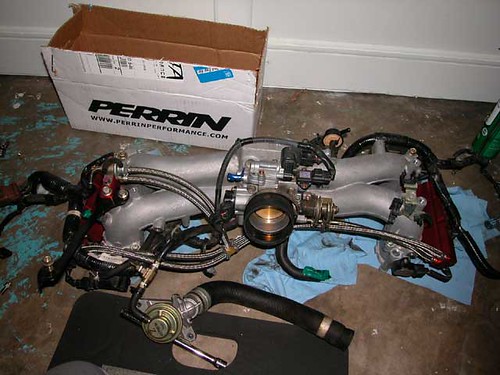
When I took my car to the dealer, I was slightly over 50k miles, and they refused to do the service under warranty. Instead of paying the (rather large) fee to have the dealer swap in new stock lines, I decided to go ahead and install some after-market steel-braided lines myself. Doing this yourself is a pretty big job -- you'll be pulling A LOT of parts out of the engine bay. I've included a few photos below to illustrate:
The engine bay pulled apart. This is what you're getting into if you decide to do this yourself. Just about everything above the engine has to come off:
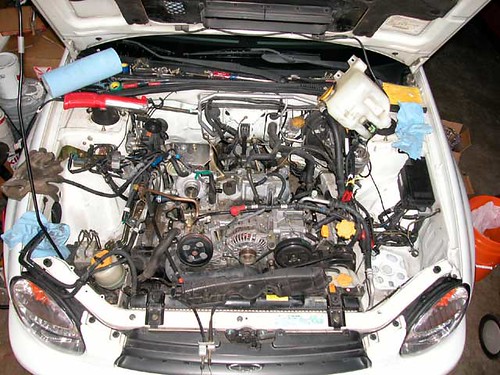
Don't forget that once you pull all those parts off, you'll need a lot of new gaskets and hoses to put it back together. If you have any other mods or maintenance you were thinking of doing, now's the time. (Ex., fuel filter, spark plugs, coolant hoses...)
The intake manifold getting the new fuel lines installed:
Back together:
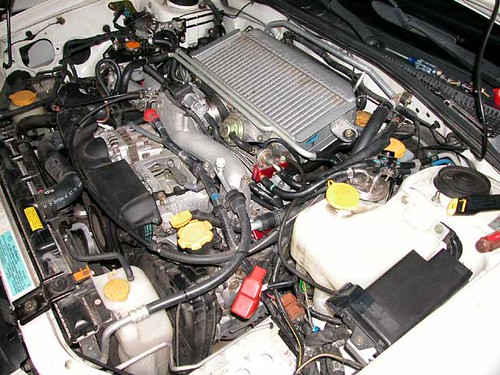
Note that "back together" means assembled, but with a number of changes. The Perrin doc's didn't mention it, but there are a few parts that will no longer fit once the larger, Perrin fuel rails are installed. Most notably are some parts known lovingly as the Green Brackets of Death. The GBD's are heavy steel pieces that cover the fuel injectors to protect them in the event of an accident. (Breaking off a fuel injector during a crash is a great way to start an engine fire.) The GBD's will no longer fit once the Perrin rails are on. Once you've come to accept this, the next thing you'll notice is that the left GBD also features some crankcase ventilation hard-line welded to it. By not re-using the GBD's, you lose this as well, and now you need a new solution for your crankcase breather hose on that side.
Testing fuel pressure with the new fuel rails:
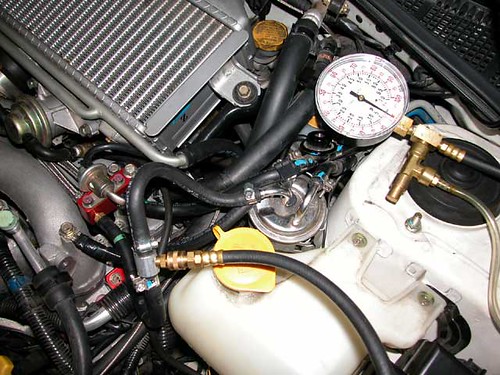
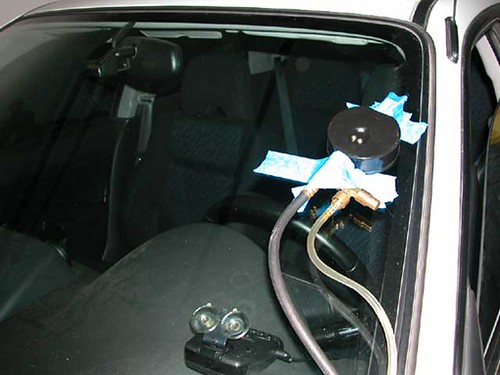
Don't try this at home, but with a little painter's tape, even a test gauge can be visible from the cabin:
[Update: 2008-08-13] Here's the Subaru Service Bulletin (#09-36-03):

Found it on this thread: http://forums.nasioc.com/forums/showthread.php?t=1421635
Googl'ing for http://www.google.com/search?hl=en&q=subaru%20service%20bulletin%20fuel%20leak also brings up a lot of info.
[Update 2010-03-02]
Looks like Subaru is finally admitting to the problem! I just got this in the mail:
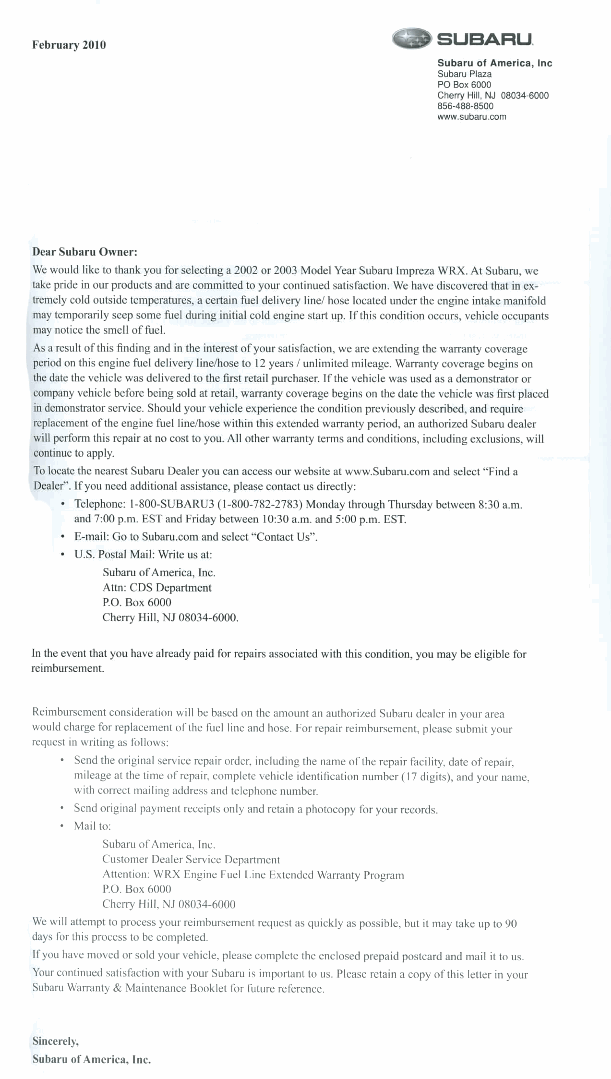
Perhaps we have the recent Toyota recall issue to thank for Subaru finally addressing this fuel leak.